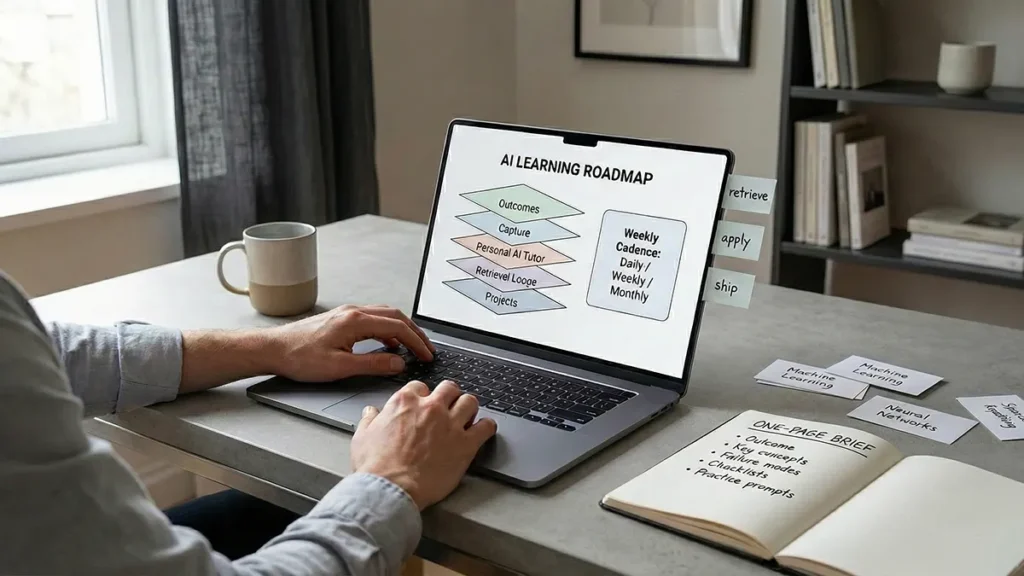
AI learning is no longer confined to classrooms, online courses, or formal training programs. It is increasingly embedded in how people read, research, and interact with knowledge itself. As artificial intelligence becomes a constant companion in everyday information workflows, the very act of learning is being reshaped in subtle but profound ways.
Instead of passively consuming books, articles, or lectures, learners now engage in continuous dialogue with intelligent systems. AI tools summarize complex material, generate alternative explanations, challenge assumptions, and adapt content to individual cognitive patterns. This shift is transforming learning from a linear process into a dynamic, interactive experience.
Table of Contents
AI learning beyond traditional education
For decades, learning followed a predictable structure: content creation by experts, distribution through books or courses, and absorption by students. AI learning disrupts this model by inserting an adaptive layer between the learner and the material. Knowledge is no longer static; it responds.
Readers can interrogate dense texts, ask for clarifications in real time, or explore related concepts without leaving the page. This changes how books function in practice. A book becomes not an endpoint, but a starting node in a broader knowledge network shaped by intelligent assistance—similar to how AI tools are transforming the way we work across modern knowledge environments.
Books, memory, and cognitive augmentation
One of the most significant effects of AI learning appears in how people retain and organize information. Instead of memorizing large volumes of content, learners increasingly rely on AI systems to surface relevant knowledge when needed. This does not eliminate understanding, but shifts emphasis toward interpretation, synthesis, and judgment.
Some reporting suggests that using generative AI during writing tasks can correlate with lower engagement in brain activity linked to attention and memory—an effect often discussed as cognitive offloading—depending on how the tool is used and how actively the user stays involved, as explored in this Scientific American analysis. In learning contexts, that’s a reminder that AI support works best when learners remain engaged rather than simply accepting outputs.
At a systems level, education authorities are responding less with blanket bans and more with guidance around responsible use, assessment integrity, and capacity-building for teachers and students—an approach reflected in the discussion of governance trends in the OECD’s Digital Education Outlook.
AI as a personalized learning layer
Traditional educational content is designed for broad audiences. AI learning systems, by contrast, adapt continuously. They adjust explanations based on prior interactions, reframe concepts using analogies that resonate with the user, and revisit ideas from multiple perspectives until clarity emerges.
This personalization extends beyond formal study. Professionals use AI to explore unfamiliar domains, connect ideas across disciplines, and revisit foundational knowledge when context changes. Learning becomes situational rather than sequential, responding to immediate intellectual needs—and often reducing the mental overhead described in cognitive load at work.
The risks of shallow understanding
Despite its advantages, AI learning introduces real risks. Overreliance on summaries or generated explanations can lead to surface-level comprehension. When learners accept outputs without scrutiny, understanding becomes fragile and dependent on the system’s framing.
Concerns about overdependence, transparency, privacy, and the need for human-centered capacity-building have been repeatedly emphasized in policy guidance for education and research, including UNESCO’s recommendations on generative AI.
Learning literacy in the age of AI
As AI becomes embedded in books and learning environments, a new form of literacy is emerging. Learning literacy involves knowing when to rely on AI support, when to slow down, and how to interrogate generated knowledge. It requires awareness of model limitations, bias, and uncertainty.
This mirrors broader discussions about how AI tools influence professional reasoning and decision-making. Learning is no longer only about acquiring information, but about managing an intelligent interface between curiosity and understanding.
A future where learning is continuous
AI learning points toward a future where education is not a phase of life, but an ongoing process woven into daily activity. Books, courses, and knowledge repositories remain essential—but they are increasingly activated through intelligent systems that adapt, contextualize, and respond.
The most valuable skill in this environment may not be speed or recall, but the ability to think clearly in collaboration with machines. In that sense, AI does not replace learning. It redefines what learning demands from us.