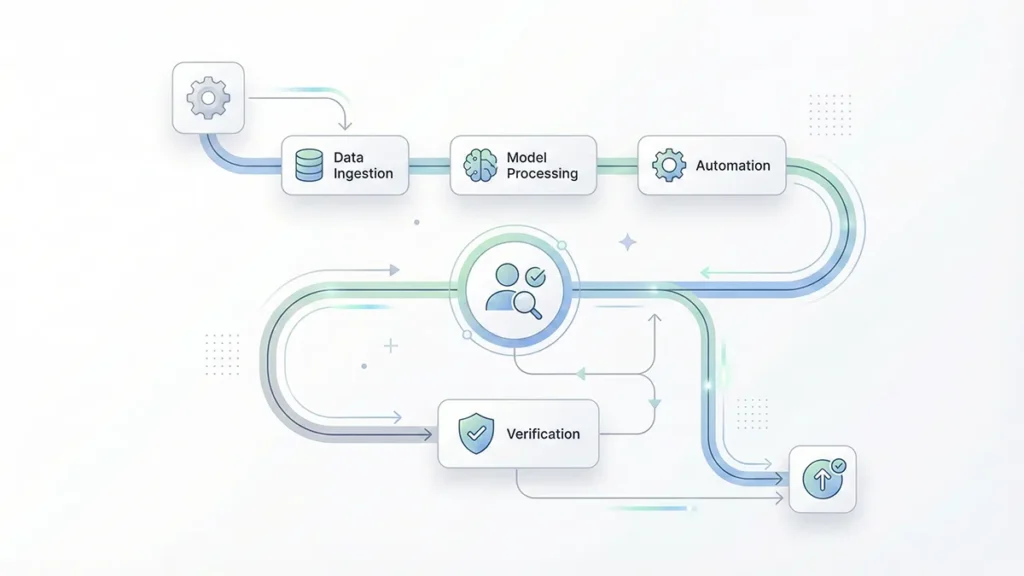
AI automation is no longer about replacing repetitive tasks or eliminating manual steps from workflows. It is increasingly reshaping how productivity itself is defined, shifting attention away from speed and volume toward clarity, focus, and decision quality.
As intelligent systems become embedded across everyday tools, automation operates less like a mechanical shortcut and more like a cognitive layer that reorganizes how work unfolds. In many organizations, productivity gains now come less from doing things faster and more from doing fewer unnecessary things.
Table of Contents
From task automation to workflow intelligence
Early automation focused on execution: triggering actions, moving data, or following predefined rules. Today, AI automation operates higher in the workflow stack. Systems interpret context, prioritize actions, and suggest next steps based on evolving conditions rather than fixed logic.
This shift reflects a broader transition toward adaptive software. Instead of reacting to user input alone, systems continuously evaluate signals such as urgency, historical behavior, and environmental constraints. This logic mirrors how productivity platforms increasingly integrate decision support into daily routines.
The result is not simply faster work, but smoother work. Intelligent automation reduces the need to constantly reorient attention, a dynamic closely related to how AI reduces cognitive load at work across complex digital environments.
Automation as a productivity stabilizer
Productivity is often framed as doing more in less time. AI automation challenges that logic. By reducing fragmentation, it helps people maintain continuity across tasks rather than constantly switching contexts.
Coverage examining how modern software reorganizes workflows shows that many productivity gains come from fewer interruptions rather than higher output. Research-backed reporting on workplace automation highlights how intelligent systems increasingly filter information before it reaches the user, stabilizing attention instead of accelerating pace.
This approach aligns with broader observations on AI’s impact on productivity. Analysis from the Financial Times on how artificial intelligence is changing the world of productivity discusses how enterprises deploy AI not just for task execution but for systemic workflow improvements that enhance efficiency at scale.
Where automation quietly changes daily work
Much of AI automation’s impact goes unnoticed because it operates in the background. Emails are summarized before being read. Meetings are distilled into action points. Documents evolve through assisted drafting rather than blank-page creation.
These micro-interventions accumulate. Over time, they reshape how people allocate attention, structure time, and evaluate progress. This mirrors patterns already visible in how AI tools are transforming the way we work, where the most meaningful changes happen incrementally.
Industry reporting on productivity software adoption shows that teams often underestimate the cumulative effect of these small adjustments. Automation does not announce itself; it normalizes new expectations about focus and flow.
Productivity without constant acceleration
One of the less discussed consequences of AI automation is its potential to slow things down—strategically. By filtering noise and clarifying intent, automation allows professionals to spend more time on judgment rather than execution.
This idea echoes broader debates over how AI’s productivity gains will unfold over the long term. Discussions in financial journalism stress that many expected benefits depend on deep integration and organizational adoption rather than simple tool rollout.
The limits of automated efficiency
AI automation is not without risk. Over-automation can obscure reasoning, reduce transparency, and encourage passive acceptance of system outputs. When automation replaces understanding instead of supporting it, productivity gains become fragile.
Concerns about excessive automation appear frequently in discussions around responsible AI deployment, particularly where systems influence decisions without clear visibility into underlying logic. Maintaining human oversight remains essential.
Why automation now defines modern productivity
As work grows more complex, productivity depends less on speed and more on managing complexity without exhaustion. AI automation addresses this challenge not by eliminating work, but by reshaping how effort is distributed.
The future of productivity will not be defined by how much work gets automated, but by how intelligently automation supports human focus, reasoning, and sustained attention.