The growing presence of AI in the workplace is changing how people manage information, pace their tasks, and make decisions. One of the clearest impacts appears in the way intelligent systems reduce cognitive load—the mental effort required to process, prioritize, and act on complex streams of data. As workflows become more intricate, AI has started functioning as a stabilizing layer that helps professionals stay focused instead of overwhelmed.
A broad body of recent research, including findings from MIT and Stanford, suggests that well-designed AI assistance can ease mental strain by simplifying synthesis tasks and clarifying next steps. Rather than replacing judgment, these systems absorb part of the burden that typically competes for human attention.
Table of Contents
Why cognitive load matters in modern workflows
Cognitive load shapes everything from decision quality to emotional resilience at work. High-pressure environments often force people to jump between documents, messages, dashboards, and deadlines with little continuity. This fragmentation increases mental fatigue, slows reasoning, and encourages reactive behaviors. When the mind spends too much energy simply organizing information, there is little left for meaningful analysis.
AI tools integrated into everyday platforms help counter this fragmentation. Assistants embedded in email clients, project software, or writing environments reorganize scattered inputs into coherent structures, reducing the effort required to “hold everything in working memory.” This dynamic appears frequently in discussions of AI-enhanced productivity, where mental clarity is treated as a form of operational advantage.
How intelligent systems reduce cognitive load
AI systems are particularly effective at reducing cognitive load when they act as intermediaries between information and action. They summarize long threads of communication, identify relevant signals in noisy data, and convert vague goals into structured outlines. For many workers, this lowers the background tension that comes from managing too many open mental loops at once.
One example appears in planning tasks. Instead of manually sorting fragmented notes, intelligent assistants generate clean action plans and highlight dependencies. In creative settings, they suggest variations that help users explore options without exhausting working memory. These patterns echo broader findings tracked in the AI Index, which documents how organizations adopt systems that streamline interpretation before execution.
Cognitive load and the future of decision support
The strategic value of AI becomes even clearer in decision-making environments. Managers and analysts often work under conditions where small interpretive errors cascade into larger operational issues. By filtering information, organizing inputs, and presenting multiple paths forward, AI reduces the cognitive load associated with uncertainty. This helps professionals maintain clarity during high-stakes assessments.
In sectors where rapid reaction matters—finance, logistics, product development, public policy—AI-driven decision support frameworks allow teams to evaluate scenarios without drowning in variables. These systems complement the growing interest in more advanced creative workflows, especially as AI begins to influence the kinds of ideas teams are able to generate and refine.
The psychological dimension of AI-assisted work
Reducing cognitive load isn’t only a technical benefit—it has psychological consequences as well. Studies in Nature Human Behaviour show that when part of the mental sorting process is offloaded to AI, people approach problems with more confidence and creativity. Mental resources previously spent on organization or recall can instead support analysis, ideation, and deeper reflection.
This shift changes the tone of everyday work. Rather than feeling pursued by loose ends, professionals experience a sense of cognitive stability. It’s a subtle but meaningful transition: when the mind is no longer overwhelmed by micro-tasks, it becomes easier to think strategically, communicate clearly, and maintain attention during complex reasoning.
What an AI-supported workflow looks like
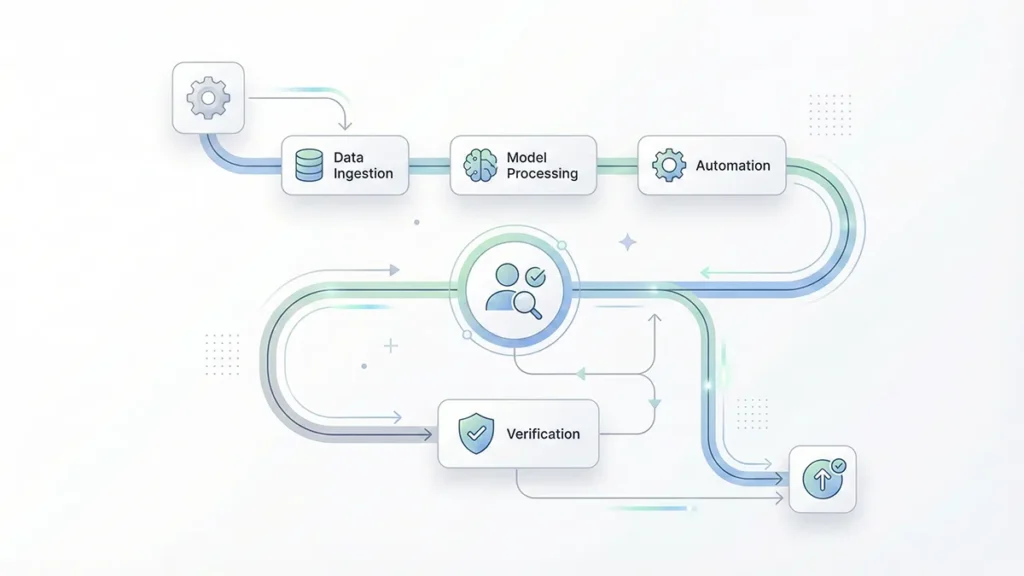
In practice, an AI-supported workflow is neither fully automated nor rigid. It is adaptive. Assistants learn individual patterns, fill contextual gaps, and provide structure in moments when mental bandwidth becomes scarce. This flexibility allows workers to offload routine interpretation while maintaining authority over the final output.
These workflows also scale. A designer can explore more directions without cognitive fatigue. A researcher can analyze more sources without losing the thread. And a business team can coordinate decisions with fewer mental bottlenecks. As these practices spread, they echo broader shifts in hybrid creative processes, where AI amplifies human intuition—a theme explored in depth in machine-assisted creativity.
A workplace shaped by cognitive clarity
The future of work will be defined less by what AI automates and more by how it supports cognitive clarity. Reducing cognitive load allows people to operate with sharper focus, steadier attention, and greater interpretive power. In a landscape where complexity continues to grow, these qualities become competitive advantages rather than luxuries.
As organizations adopt systems that stabilize mental bandwidth, workers gain the freedom to concentrate on decisions that actually matter. AI tools will continue to evolve, but their most meaningful contribution may be the simplest: giving people space to think.