For decades, creative work was framed as the last frontier of purely human talent. Yet in studios, agencies, production houses, and home offices, machine-assisted creativity is quietly becoming part of the daily routine. Instead of replacing imagination, AI is slipping into the spaces between ideas, drafts, and revisions—accelerating some stages, complicating others, and forcing artists, writers, and designers to rethink what it means to “create”.
Generative systems can now propose alternative storylines, synthesize visual concepts, remix musical themes, and generate stylistic variations at a scale that would have been impossible with traditional tools alone. Research in Nature Human Behaviour argues that state-of-the-art generative models can match human performance in creativity tests and are increasingly augmenting human ideation rather than merely imitating it. These findings reinforce how machine-assisted creativity functions as a catalyst rather than a replacement for human insight.
Table of Contents
What machine-assisted creativity really looks like
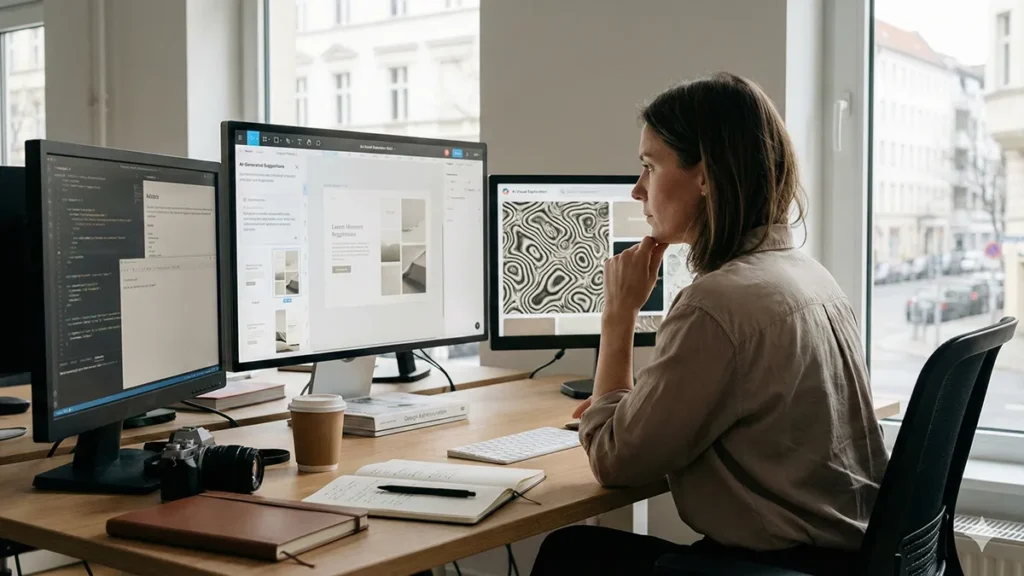
In practice, machine-assisted creativity rarely resembles the myth of a fully automated genius engine. It appears in smaller, more granular interventions: a language model suggesting alternative openings for a script, an image system proposing lighting variations, or a music model exploring rhythmic patterns. The human creator still defines direction, taste, and constraints, while the AI expands the search space through machine-assisted creativity techniques that make exploration faster and more flexible.
This new creative loop shifts teams away from purely linear workflows. Instead of moving from idea to sketch to refinement, creators oscillate between human intention and machine-generated possibilities. Studies in Science Advances show that AI-assisted suggestions can improve perceived creativity and writing quality, especially among less experienced practitioners. Yet these benefits appear strongest when humans remain active evaluators, a core principle in effective machine-assisted creativity workflows.
Creative industries under algorithmic pressure
The impact of AI is especially visible in design, film, advertising, and entertainment. Tools that once existed only in experimental labs are now embedded in mainstream software used for editing, layout, and production. Reports across creative sectors indicate that a significant portion of repetitive or procedural work can be automated without removing the need for human vision and direction—one of the central promises of machine-assisted creativity in industrial environments.
For many teams, this means less energy spent on time-consuming operational tasks—resizing assets, generating small variations, cleaning audio—and more attention devoted to narrative intent and overall coherence. This shift parallels broader transformations in how AI tools are transforming the way we work across knowledge industries: machines absorb part of the cognitive and operational load, freeing humans to focus on meaning and strategy. In this sense, machine-assisted creativity becomes part of a larger movement reshaping knowledge work.
As machine-assisted creativity spreads, debates around authorship intensify. When an AI-generated draft evolves into a final work, who deserves credit? Some scholars argue for models of shared authorship, while others emphasize the difference between curatorial selection and creative origin. Interestingly, early studies of audience responses suggest that people judge works less by how they were made and more by the intention and emotional coherence they perceive.
Concerns about labor dynamics are also resurfacing. While AI may boost aggregate productivity, it can compress early-career opportunities or shift value toward those who master hybrid creative workflows. This raises questions about economic equity in creative professions, not simply automation. The rise of machine-assisted creativity deepens these tensions by rewarding those who can orchestrate both human and computational strengths.
Skills for the era of machine-assisted creativity
Working effectively with AI in creative domains demands more than technical proficiency. It requires the ability to frame good prompts, articulate constraints, recognize subtle failures, and critique machine-generated work with clarity. In this sense, machine-assisted creativity amplifies the importance of human judgment over mechanical skill.
Research on human–AI collaboration shows that mixed teams do not always outperform humans or AI alone; results depend on how actively humans remain engaged. Creators who rely too heavily on AI often experience conceptual drift, while those who treat AI as a brainstorming partner tend to produce more original results.
Educational programs are beginning to adapt. Alongside traditional instruction—composition, narrative design, color theory—students now learn prompt design, data ethics, hybrid workflows, and systematic evaluation of AI outputs. These shifts parallel broader discussions about the competencies required for future creative work, many of which are rooted in principles of machine-assisted creativity as both a methodology and a mindset.
Rethinking imagination in a hybrid world
Machine-assisted creativity is not a temporary trend; it is becoming part of the cultural infrastructure shaping how ideas emerge and develop. The most compelling outcomes rarely come from purely automated systems or purely manual craft—they arise from collaborations in which machines widen the field of possibilities and humans choose which paths are worth following.
As AI systems grow more capable and more integrated into creative tools, a central question emerges: not whether AI can be creative, but what kinds of creative futures humans want to cultivate. Some will prioritize speed and scale; others will emphasize nuance, interpretation, and the emotional depth only humans can provide. In this hybrid landscape, machine-assisted creativity becomes both a practical tool and a philosophical framework for understanding the next era of imagination.