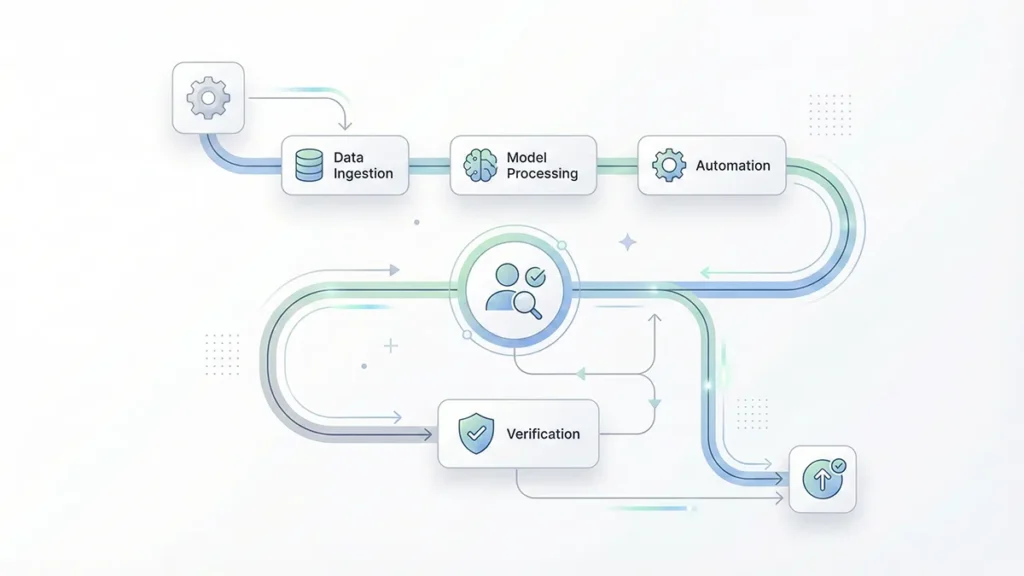
AI workflow orchestration is quietly becoming the difference between “we use AI” and “AI actually works here.” As teams add more tools, prompts, agents, and automations, the real bottleneck is no longer model capability. It’s coordination.
When AI workflows are improvised, productivity gains feel random. When they are orchestrated, AI becomes infrastructure: predictable, auditable, and calm. This is why AI workflow orchestration is emerging as a core discipline for knowledge work in 2026.
Table of Contents
- Why AI workflow orchestration matters more than better prompts
- What AI workflow orchestration actually means
- The hidden cost of un-orchestrated AI automation
- AI workflow orchestration vs. agentic workflows
- The building blocks of reliable AI workflow orchestration
- A practical example: orchestrating a weekly reporting workflow
- Why orchestration enables scale
- Common mistakes that break AI workflow orchestration
- How to start small with AI workflow orchestration
- The calm advantage
Why AI workflow orchestration matters more than better prompts
Most organizations start their AI journey with individual use cases: a summarizer here, a drafting tool there, an automation script bolted onto an existing process. At small scale, this feels efficient. At scale, it becomes brittle — especially when different teams interpret “done” differently and nobody can explain why the system produced what it produced.
AI workflow orchestration exists to solve this exact problem. It is the practice of designing how AI systems, humans, tools, and verification steps interact across a full workflow, not just inside a single prompt.
This shift mirrors what happened in software years ago. Writing scripts was never the hard part. Running them reliably in production was. AI is going through the same transition.
What AI workflow orchestration actually means
AI workflow orchestration is not a tool. It is a system design mindset.
At its core, it answers four questions:
- What task is AI responsible for?
- What information is it allowed to see?
- What actions can it propose or execute?
- How are outputs verified before consequences occur?
In practice, this means chaining AI capabilities into repeatable flows with clear boundaries. Drafting is separated from deciding. Recommending is separated from acting. Automation is paired with checkpoints.
That boundary mindset is one of the clearest signs you’re moving from “AI experiments” to operational maturity.
Teams often feel the pain before they can name it. Outputs look inconsistent. Errors slip through. People lose trust and quietly stop using the tools.
Without AI workflow orchestration, automation tends to fail in three predictable ways.
1) Context drift
AI systems lose track of intent when workflows span multiple steps. A summarizer forgets constraints. A planner ignores edge cases. The result is output that is plausible but misaligned.
If you’ve watched a tool perform well in a demo and wobble in real workflows, you’ve already met the problem of context reliability.
When outputs flow directly into actions, AI gains authority it was never meant to have. Emails get sent. Records get updated. Decisions harden before anyone reviews them.
This is where automation turns from helpful to risky. Orchestration inserts explicit decision boundaries.
3) Cognitive overload
Ironically, poorly designed automation increases mental load. Users must constantly double-check outputs, re-explain goals, and clean up mistakes.
Well-orchestrated workflows do the opposite. They reduce mental overhead by tightening inputs, clarifying expectations, and keeping humans in the loop at the moments that matter — the kind of workflow hygiene that tends to pay back fast.
AI workflow orchestration vs. agentic workflows
Agentic workflows are often framed as the future: AI systems that plan, act, and adapt autonomously. AI workflow orchestration is what makes that future survivable.
The difference is subtle but critical.
- Agentic workflows focus on autonomy.
- AI workflow orchestration focuses on control, sequencing, and reliability.
In mature systems, the two coexist. Agents operate inside orchestrated pipelines with scoped permissions, review steps, and audit trails.
This is why organizations that skip orchestration often stall after initial excitement. Autonomy without structure feels impressive until something goes wrong.
The building blocks of reliable AI workflow orchestration
Effective orchestration does not require complex tooling. It requires disciplined design.
Clear task decomposition
Each step should have a single job: summarize, extract, draft, evaluate, or decide. When steps blend together, verification becomes impossible.
Defined input contracts
AI should know what kind of input it is receiving. Any text pulled from outside the system should be treated as content, not instructions — a habit that becomes non-negotiable once your workflow touches browsing, email, tickets, PDFs, or shared docs. That’s why teams increasingly build defensive boundaries into their daily AI usage.
Structured outputs
Free-form text is fragile. Structured outputs — lists, tables, schemas — make downstream steps predictable and auditable. If you’ve ever shipped an AI workflow into production, you already know why typed fields and strict schemas matter more than eloquent paragraphs.
That design preference shows up in how modern platforms push developers toward tool schemas instead of “just text.”
Human-in-the-loop checkpoints
Orchestration does not remove humans. It places them where judgment matters most. Review steps should show rationale, evidence, and proposed actions clearly.
A practical example: orchestrating a weekly reporting workflow
Consider a common automation goal: weekly performance reporting.
Without orchestration, teams ask AI to “summarize everything.” Results vary. Errors slip in. Trust erodes.
With AI workflow orchestration, the flow changes:
- Step 1: Collect data sources (no interpretation).
- Step 2: Extract key metrics (structured output).
- Step 3: Draft narrative summary.
- Step 4: Flag anomalies and uncertainty.
- Step 5: Human review and approval.
The AI does more work, not less. The difference is that its work is bounded and reviewable.
Why orchestration enables scale
Scaling AI is not about running more prompts. It is about running the same workflow reliably across people, teams, and weeks.
This is where AI workflow orchestration becomes a management tool, not just a technical one. Leaders gain visibility. Teams gain confidence. Errors become debuggable instead of mysterious.
There’s a reason mature AI programs start to look like operations: coverage, repeatability, measurable drift, and governance that can survive leadership changes. The organizations that get this right tend to treat automation as a capability stack, not a bundle of apps — the shift you see when discussions move from pilots to enterprise-scale rollout.
These benefits compound over time, much like the gains described in workflow compounding.
Common mistakes that break AI workflow orchestration
Over-automation too early
Skipping review steps to “save time” often costs more time later. Trust is harder to rebuild than speed.
Invisible assumptions
If a workflow relies on unstated rules, AI will eventually violate them. Orchestration makes assumptions explicit.
Tool-first thinking
Buying orchestration software before designing the workflow usually fails. Process clarity must come first.
How to start small with AI workflow orchestration
You do not need a platform overhaul. Start with one recurring task that matters.
- Write the steps on paper.
- Label which steps AI supports.
- Define one verification point.
That single orchestrated workflow often delivers more value than dozens of isolated AI experiments.
The calm advantage
The most overlooked benefit of AI workflow orchestration is emotional. Well-designed systems feel calm. People stop worrying about silent failures and start trusting outputs again.
In a landscape where AI capabilities evolve rapidly but infrastructure constraints remain real, orchestration is what turns possibility into reliability.
AI workflow orchestration is not about controlling intelligence. It is about designing systems that let intelligence work — consistently, safely, and at scale.